⊗This PRODUCT IS INTENDED AS A RESEARCH CHEMICAL ONLY. This designation allows the use of research chemicals strictly for in vitro testing and laboratory experimentation only. All product information available on this website is for educational purposes only. Bodily introduction of any kind into humans or animals is strictly prohibited by law. This product should only be handled by licensed, qualified professionals. This product is not a drug, food, or cosmetic and may not be misbranded, misused or mislabeled as a drug, food, or cosmetic.
⊗This PRODUCT IS INTENDED AS A RESEARCH CHEMICAL ONLY. This designation allows the use of research chemicals strictly for in vitro testing and laboratory experimentation only. All product information available on this website is for educational purposes only. Bodily introduction of any kind into humans or animals is strictly prohibited by law. This product should only be handled by licensed, qualified professionals. This product is not a drug, food, or cosmetic and may not be misbranded, misused or mislabeled as a drug, food, or cosmetic.
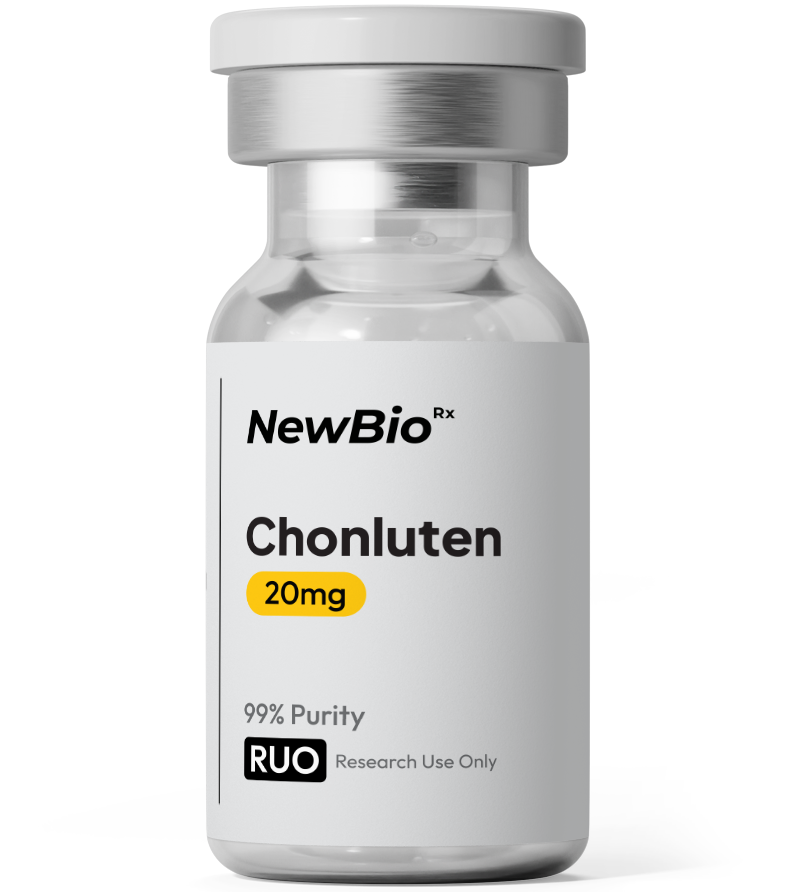
Chonluten 20mg
Peptides
What is Chonluten?
Chonluten (also designated as tripeptide T-34 or EDG peptide) is a synthetic short-chain peptide bioregulator consisting of three amino acids in the sequence Glutamic acid-Aspartic acid-Glycine (Glu-Asp-Gly). This tripeptide was originally identified and isolated from bronchial epithelial cells as part of research into organ-specific peptide bioregulators conducted at the St. Petersburg Institute of Bioregulation and Gerontology.
Chonluten belongs to the family of Khavinson peptides, a class of short bioactive peptides characterized by Professor Vladimir Khavinson beginning in the 1970s. These peptides are distinguished by their tissue-specific actions and ability to regulate gene expression and protein synthesis. Chonluten specifically demonstrates primary biological activity in respiratory system tissues, with secondary effects observed in gastrointestinal tissues.
The peptide's mechanism of action involves direct interaction with cellular signaling pathways and potential binding to DNA regulatory regions. Chonluten has been synthesized based on the natural peptide sequences found in bronchial tissue, allowing for standardized research applications. The molecular formula is C₁₁H₁₇N₃O₈ with a molecular weight of 319.27 g/mol.
Research indicates Chonluten functions as an epigenetic regulator, potentially influencing gene expression through interactions with chromatin structure and transcription factors. The peptide demonstrates the ability to penetrate cell membranes and access nuclear compartments where it may modulate expression of genes involved in inflammation, oxidative stress response, and cellular proliferation. Studies suggest Chonluten regulates genes encoding proteins such as c-Fos, heat shock protein 70 (HSP70), superoxide dismutase (SOD), cyclooxygenase-2 (COX-2), and tumor necrosis factor-alpha (TNF-α).
The peptide's tissue specificity for respiratory epithelium makes it a subject of investigation for understanding peptide-mediated regulation of bronchial mucosal function and inflammatory responses in the respiratory system.
Research Applications
Anti-Inflammatory and Immune Modulation
Research published in the International Journal of Molecular Sciences demonstrates that Chonluten exhibits significant anti-inflammatory properties through modulation of immune cell function and cytokine production. In experimental studies using human monocytic cell lines (THP-1 cells), Chonluten treatment resulted in substantial reduction of pro-inflammatory mediators.
When monocytes were exposed to bacterial lipopolysaccharide (LPS), a potent inflammatory trigger, Chonluten pre-treatment inhibited tumor necrosis factor (TNF) production. This reduced TNF release is linked to a mechanism of TNF tolerance, whereby the peptide promotes attenuation of inflammatory activity in immune cells. The peptide demonstrated ability to inhibit expression of multiple pro-inflammatory cytokines including TNF and interleukin-6 (IL-6) when immune cells were stimulated with LPS.
Studies show Chonluten treatment of differentiated macrophages resulted in decreased secretion of IL-6, TNF-α, and IL-17—all key mediators of inflammatory responses. The peptide's capacity to downregulate IL-17 is particularly significant, as this cytokine plays central roles in chronic inflammatory conditions and autoimmune responses. By reducing these inflammatory cytokines, Chonluten demonstrates potential for modulating excessive immune activation.
Research indicates Chonluten acts on macrophages as an anti-inflammatory molecule during inflammatory and microbial-mediated activity, functioning as a natural inducer of immune tolerance. This anti-inflammatory action occurs through modulation of intracellular signaling pathways rather than through traditional receptor-mediated mechanisms.
Sources:
- Avolio F, Martinotti S, Khavinson VK, Esposito JE, Giambuzzi G, Marino A, Mironova E, Pulcini R, Robuffo I, Bologna G, Simeone P, Lanuti P, Guarnieri S, Trofimova S, Procopio AD, Toniato E. Peptides Regulating Proliferative Activity and Inflammatory Pathways in the Monocyte/Macrophage THP-1 Cell Line. Int J Mol Sci. 2022;23(7):3607. https://pmc.ncbi.nlm.nih.gov/articles/PMC8999041/
Cellular Signaling and Gene Regulation
Chonluten demonstrates capacity to activate specific intracellular signaling pathways involved in cellular stress responses and immune function. Research shows the peptide activates STAT1 (Signal Transducer and Activator of Transcription 1), a critical transcription factor involved in interferon signaling and immune responses.
In studies using macrophage-differentiated THP-1 cells, Chonluten treatment increased phosphorylation of STAT1 in a time-dependent manner, with maximum activation occurring between 4-8 hours after treatment. Notably, this STAT1 activation occurred through a receptor-independent mechanism, as Chonluten treatment did not induce interferon-alpha (IFN-α) production. This suggests the peptide may directly engage intracellular signaling pathways after cell entry, rather than acting through traditional surface receptor binding.
Confocal microscopy studies confirmed that Chonluten promotes translocation of activated STAT1 from the cytoplasm into cell nuclei, where it can regulate gene transcription. This nuclear localization of STAT1 is essential for its function as a transcription factor controlling genes involved in immune responses and cellular defense mechanisms.
Research indicates Chonluten also modulates STAT3 signaling, though with opposite effects compared to STAT1. While STAT3 is typically activated during acute inflammatory responses and promotes IL-6 production, Chonluten treatment showed tendency to reduce STAT3 phosphorylation when cells were co-treated with inflammatory stimuli. This differential regulation of STAT signaling pathways suggests Chonluten may help shift cellular responses from pro-inflammatory to resolution-promoting states.
Studies demonstrate Chonluten influences proliferative signaling by increasing tyrosine phosphorylation of mitogen-activated protein kinases (MAPK), specifically ERK1/2. These kinases play central roles in cell proliferation, differentiation, and survival responses.
Sources:
- Avolio F, Martinotti S, Khavinson VK, Esposito JE, Giambuzzi G, Marino A, Mironova E, Pulcini R, Robuffo I, Bologna G, Simeone P, Lanuti P, Guarnieri S, Trofimova S, Procopio AD, Toniato E. Peptides Regulating Proliferative Activity and Inflammatory Pathways in the Monocyte/Macrophage THP-1 Cell Line. Int J Mol Sci. 2022;23(7):3607. https://pmc.ncbi.nlm.nih.gov/articles/PMC8999041/
Vascular and Cellular Adhesion Modulation
Research demonstrates Chonluten significantly affects immune cell-endothelial cell interactions, a critical process in inflammatory responses and tissue repair. In cell-cell adhesion assays, pre-treatment of monocytes with Chonluten resulted in substantial reduction in their adhesion to activated human umbilical vein endothelial cells (HUVECs).
When endothelial cells were activated with lipopolysaccharide (LPS) to simulate inflammatory conditions, monocytes pre-treated with Chonluten showed decreased ability to adhere to the activated endothelium. This reduced adhesion represents an important anti-inflammatory mechanism, as excessive immune cell adhesion and infiltration into tissues contributes to chronic inflammation and tissue damage.
The adhesion of circulating monocytes to vascular endothelium is a key early step in inflammatory responses, allowing immune cells to migrate from bloodstream into tissues. By reducing this adhesion process, Chonluten may help limit excessive immune cell recruitment and subsequent inflammatory tissue damage. This mechanism suggests potential applications in conditions characterized by excessive leukocyte-endothelial interactions.
Studies measured adhesion through quantification of fluorescently-labeled monocytes binding to endothelial monolayers, with confocal microscopy confirming reduced cell-cell interactions following Chonluten treatment. The peptide's ability to modulate this fundamental inflammatory process demonstrates its multi-level effects on immune system function.
Sources:
- Avolio F, Martinotti S, Khavinson VK, Esposito JE, Giambuzzi G, Marino A, Mironova E, Pulcini R, Robuffo I, Bologna G, Simeone P, Lanuti P, Guarnieri S, Trofimova S, Procopio AD, Toniato E. Peptides Regulating Proliferative Activity and Inflammatory Pathways in the Monocyte/Macrophage THP-1 Cell Line. Int J Mol Sci. 2022;23(7):3607. https://pmc.ncbi.nlm.nih.gov/articles/PMC8999041/
Cellular Proliferation and Differentiation
Chonluten demonstrates effects on cellular proliferation patterns and cell cycle progression in immune cells. Research using human monocytic cell lines shows the peptide influences growth rates and proliferative activity while maintaining balanced distribution across cell cycle phases.
Studies examining cell cycle distribution in Chonluten-treated monocytes revealed the peptide increases proliferative markers while simultaneously showing some degree of apoptotic activity. This dual effect suggests Chonluten may promote cellular turnover and renewal processes, eliminating senescent or damaged cells while supporting proliferation of healthy cells.
The peptide influences production of extracellular vesicles (EVs), which serve as cellular communication shuttles carrying nucleic acids and proteins. In proliferating monocytes, Chonluten treatment affected EV production levels, with notable effects observed when cells were co-treated with inflammatory stimuli. Extracellular vesicle production reflects cellular metabolic activity and communication capacity, suggesting Chonluten modulates fundamental cellular functions.
Research indicates Chonluten activates mitogen-activated protein kinases including ERK1/2 and stress-related kinases such as c-Jun N-terminal kinase (JNK). ERK1/2 activation is associated with cell proliferation and differentiation signals, while JNK activation relates to cellular stress responses and adaptation to oxidative challenges. This activation pattern suggests Chonluten coordinates both growth-promoting signals and protective stress response mechanisms.
The peptide's effects on cellular differentiation are evidenced by its tissue-specific activity and original derivation from specialized bronchial epithelial cells, indicating potential roles in maintaining differentiated cell phenotypes and tissue-specific functions.
Sources:
- Avolio F, Martinotti S, Khavinson VK, Esposito JE, Giambuzzi G, Marino A, Mironova E, Pulcini R, Robuffo I, Bologna G, Simeone P, Lanuti P, Guarnieri S, Trofimova S, Procopio AD, Toniato E. Peptides Regulating Proliferative Activity and Inflammatory Pathways in the Monocyte/Macrophage THP-1 Cell Line. Int J Mol Sci. 2022;23(7):3607. https://pmc.ncbi.nlm.nih.gov/articles/PMC8999041/