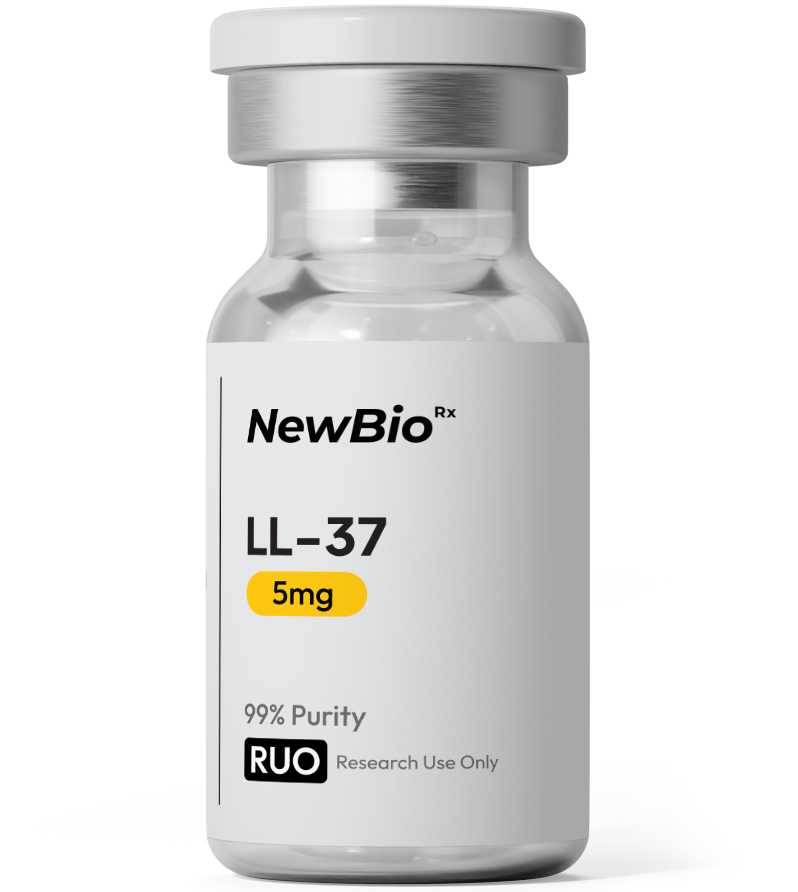
What is LL-37?
LL-37 (Leucine-Leucine-37) is a naturally occurring antimicrobial peptide representing the only member of the cathelicidin family expressed in humans. This 37-amino acid peptide is proteolytically cleaved from the 18 kDa precursor protein human cationic antimicrobial protein (hCAP18) by proteinase-3 in neutrophils and kallikrein in keratinocytes. The peptide's name derives from its two N-terminal leucine residues and its total length of 37 amino acids.
LL-37 carries a net positive charge of +6 and adopts an amphipathic α-helical structure in physiological conditions, allowing it to interact effectively with negatively charged bacterial membranes while preserving mammalian cell membrane integrity. The peptide is constitutively produced in neutrophil granules and is inducibly expressed in epithelial cells lining barrier organs including skin, respiratory tract, gastrointestinal tract, and urogenital tissues in response to infection, inflammation, or tissue injury.
The peptide functions as a multifunctional effector molecule of innate immunity, exhibiting direct antimicrobial activity through membrane disruption while simultaneously exerting immunomodulatory effects through multiple cell surface receptors. LL-37 interacts with several structurally unrelated receptors including formyl peptide receptors (FPR1/FPR2), P2X7 purinergic receptor, epidermal growth factor receptor (EGFR), and integrin Mac-1 (CD11b/CD18), mediating diverse cellular responses including chemotaxis, cytokine regulation, wound healing, and autophagy activation.
Endogenous LL-37 expression is strongly induced during skin wounding, reaching peak levels at 48 hours post-injury before declining as wounds heal. Significantly, LL-37 levels are notably reduced or absent in chronic non-healing ulcers, suggesting its critical role in normal wound closure. The peptide's expression is regulated by multiple factors including vitamin D3 metabolites, inflammatory cytokines (particularly IL-17 and IL-36), bacterial products, and tissue damage signals, positioning it as a key coordinator between innate immune defense and tissue repair mechanisms.
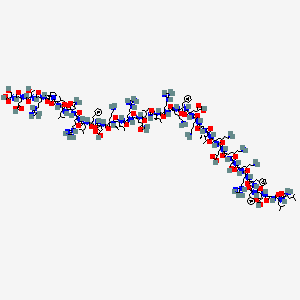
LL-37 Structure
Chemical Structure
2D Structure
3D Structure

Chemical Properties
| CAS Number | 154947-66-7 |
|---|---|
| Molecular Formula | C205H340N60O53 |
| Molecular Weight | 4493 g/mol |
| IUPAC Name |
(4S)-5-[[(2S)-6-amino-1-[[(2S,3S)-1-[[2-[[(2S)-6-amino-1-[[(2S)-1-[[(2S)-1-[[(2S)-6-amino-1-[[(2S)-1-[[(2S,3S)-1-[[(2S)-1-[[(2S)-5-amino-1-[[(2S)-1-[[(2S,3S)-1-[[(2S)-6-amino-1-[[(2S)-1-[[(2S)-1-[[(2S)-1-[[(2S)-1-[[(2S)-4-amino-1-[[(2S)-1-[[(2S)-1-[(2S)-2-[[(2S)-5-carbamimidamido-1-[[(2S,3R)-1-[[(2S)-4-carboxy-1-[[(1S)-1-carboxy-2-hydroxyethyl]amino]-1-oxobutan-2-yl]amino]-3-hydroxy-1-oxobutan-2-yl]amino]-1-oxopentan-2-yl]carbamoyl]pyrrolidin-1-yl]-3-methyl-1-oxobutan-2-yl]amino]-4-methyl-1-oxopentan-2-yl]amino]-1,4-dioxobutan-2-yl]amino]-5-carbamimidamido-1-oxopentan-2-yl]amino]-4-methyl-1-oxopentan-2-yl]amino]-1-oxo-3-phenylpropan-2-yl]amino]-3-carboxy-1-oxopropan-2-yl]amino]-1-oxohexan-2-yl]amino]-3-methyl-1-oxopentan-2-yl]amino]-5-carbamimidamido-1-oxopentan-2-yl]amino]-1,5-dioxopentan-2-yl]amino]-3-methyl-1-oxobutan-2-yl]amino]-3-methyl-1-oxopentan-2-yl]amino]-5-carbamimidamido-1-oxopentan-2-yl]amino]-1-oxohexan-2-yl]amino]-1-oxo-3-phenylpropan-2-yl]amino]-4-carboxy-1-oxobutan-2-yl]amino]-1-oxohexan-2-yl]amino]-2-oxoethyl]amino]-3-methyl-1-oxopentan-2-yl]amino]-1-oxohexan-2-yl]amino]-4-[[(2S)-6-amino-2-[[(2S)-2-[[(2S)-6-amino-2-[[(2S)-2-[[(2S)-2-[[(2S)-2-[[(2S)-2-[[2-[[(2S)-2-[[(2S)-2-amino-4-methylpentanoyl]amino]-4-methylpentanoyl]amino]acetyl]amino]-3-carboxypropanoyl]amino]-3-phenylpropanoyl]amino]-3-phenylpropanoyl]amino]-5-carbamimidamidopentanoyl]amino]hexanoyl]amino]-3-hydroxypropanoyl]amino]hexanoyl]amino]-5-oxopentanoic acid
|
| InChIKey | POIUWJQBRNEFGX-XAMSXPGMSA-N |
LL-37 Research
Wound Healing and Tissue Repair
LL-37 demonstrates significant wound healing properties through multiple coordinated mechanisms. Research published in the Journal of Investigative Dermatology shows that LL-37 is strongly expressed in healing skin epithelium, with peak expression occurring 48 hours post-wounding. Studies demonstrate that antibody-mediated inhibition of LL-37 significantly impairs wound re-epithelialization and reduces epithelial cell proliferation markers, confirming its essential role in wound closure.
The peptide promotes wound healing through stimulation of keratinocyte migration via transactivation of the epidermal growth factor receptor (EGFR) pathway. Research in organ-cultured human skin models demonstrates that LL-37 treatment accelerates epithelial migration over wound beds. Notably, chronic ulcers show absent or drastically reduced LL-37 immunoreactivity in ulcer edge epithelium, directly correlating with impaired healing capacity.
LL-37 enhances angiogenesis and neovascularization in wounded tissue. Studies published in Arteriosclerosis, Thrombosis, and Vascular Biology demonstrate that LL-37 induces endothelial cell proliferation, migration, and tubule-like structure formation through activation of the COX-1/PGE2 biosynthetic pathway and subsequent EP3 receptor signaling. Animal models show that topical LL-37 application increases vascularization and accelerates re-epithelialization in healing wounds. The peptide upregulates VEGF expression and promotes the formation of functional blood vessels essential for delivering nutrients and immune cells to healing tissue.
Nanoparticle delivery systems combining LL-37 with biodegradable PLGA demonstrate enhanced wound healing outcomes. Research shows PLGA-LL37 nanoparticle treatment significantly accelerates wound closure through advanced granulation tissue formation, increased collagen deposition, improved angiogenesis, and upregulated IL-6 and VEGF expression while modulating inflammatory responses.
Sources:
- Heilborn JD, et al. "The cathelicidin anti-microbial peptide LL-37 is involved in re-epithelialization of human skin wounds and is lacking in chronic ulcer epithelium." Journal of Investigative Dermatology. 2003;120(3):379-389. https://pubmed.ncbi.nlm.nih.gov/12603850/
- Ramos R, et al. "Wound healing activity of the human antimicrobial peptide LL37." Peptides. 2011;32(7):1469-1476. https://pubmed.ncbi.nlm.nih.gov/21693141/
- Koczulla R, et al. "An angiogenic role for the human peptide antibiotic LL-37/hCAP-18." Journal of Clinical Investigation. 2003;111(11):1665-1672. https://pmc.ncbi.nlm.nih.gov/articles/PMC209411/
- Chereddy KK, et al. "Combined effect of PLGA and curcumin on wound healing activity." Journal of Controlled Release. 2013;171(2):208-215. https://pubmed.ncbi.nlm.nih.gov/23872287/
- Tokumaru S, et al. "Induction of keratinocyte migration via transactivation of the epidermal growth factor receptor by the antimicrobial peptide LL-37." Journal of Immunology. 2005;175(7):4662-4668. https://pubmed.ncbi.nlm.nih.gov/16177113/
Antimicrobial Activity and Biofilm Disruption
LL-37 exhibits broad-spectrum antimicrobial activity through direct membrane disruption mechanisms. The peptide demonstrates bactericidal activity against both Gram-positive pathogens (Staphylococcus aureus, Streptococcus species) and Gram-negative bacteria (Pseudomonas aeruginosa, Escherichia coli, Serratia marcescens), as well as antifungal activity against Candida species. Research shows LL-37 operates through a carpet-like mechanism, disrupting bacterial membrane integrity via electrostatic and hydrophobic interactions rather than forming discrete pores.
Studies demonstrate keratinocyte-derived cathelicidin provides direct defense against bacterial skin pathogens. Research using cathelicidin gene knockout mice shows these animals exhibit significantly increased susceptibility to Group A Streptococcus skin infections even when neutropenic, confirming the critical role of epithelial cell-derived LL-37 in cutaneous immune defense. Cultured keratinocytes demonstrate LL-37-dependent growth inhibition of Staphylococcus aureus, with lentivirus-mediated delivery of activated LL-37 enhancing antimicrobial activity.
LL-37 possesses significant anti-biofilm properties particularly relevant for chronic wound infections. Research demonstrates the peptide can eradicate preformed biofilms of multiple pathogens including methicillin-resistant Staphylococcus aureus (MRSA), Pseudomonas aeruginosa, and Candida albicans. Studies on diabetic foot ulcers show that polymicrobial biofilms, which affect approximately 60% of chronic wounds, are particularly susceptible to LL-37 treatment due to the peptide's ability to penetrate the protective extracellular matrix and target persister cells embedded within biofilm structures.
The anti-biofilm mechanism involves disruption of quorum sensing pathways and degradation of the extracellular polymeric matrix that protects biofilm-embedded bacteria from conventional antibiotics and immune responses. Studies demonstrate LL-37 exhibits superior anti-biofilm activity compared to traditional antiseptics, making it particularly valuable for treating chronic infected wounds where biofilm-associated infections contribute to healing failure and antibiotic resistance.
Sources:
- Braff MH, et al. "Keratinocyte production of cathelicidin provides direct activity against bacterial skin pathogens." Infection and Immunity. 2005;73(10):6771-6781. https://pubmed.ncbi.nlm.nih.gov/16177355/
- Overhage J, et al. "Human host defense peptide LL-37 prevents bacterial biofilm formation." Infection and Immunity. 2008;76(9):4176-4182. https://pmc.ncbi.nlm.nih.gov/articles/PMC2519436/
- Dean SN, et al. "Susceptibility of Pseudomonas aeruginosa biofilm to alpha-helical peptides: D-enantiomer of LL-37." Frontiers in Microbiology. 2011;2:128. https://www.frontiersin.org/journals/microbiology/articles/10.3389/fmicb.2011.00128/full
- Ridyard KE, Overhage J. "The Potential of Human Peptide LL-37 as an Antimicrobial and Anti-Biofilm Agent." Antibiotics. 2021;10(6):650. https://pmc.ncbi.nlm.nih.gov/articles/PMC8227053/
Immune Modulation and Inflammatory Regulation
LL-37 functions as a key immunomodulatory molecule, regulating inflammatory responses through multiple mechanisms. Research demonstrates the peptide significantly modulates neutrophil responses to bacterial stimulation, with studies showing LL-37 decreases release of proinflammatory cytokines (IL-1β, IL-6, IL-8, TNF-α) from LPS-stimulated neutrophils in a dose-dependent manner. This protective effect against cytokine storm development is observable with both endotoxin and whole bacterial stimulation.
Studies using CRAMP-deficient mice (murine cathelicidin ortholog) demonstrate that neutrophils lacking endogenous cathelicidin release significantly higher amounts of TNF-α following LPS stimulation compared to wild-type animals, confirming the peptide's critical role in modulating excessive inflammatory responses. This anti-inflammatory activity occurs through neutralization of lipopolysaccharide (LPS) and modulation of Toll-like receptor 4 (TLR4) activation pathways.
LL-37 exhibits potent chemotactic properties, recruiting immune cells to sites of infection and injury. Research shows the peptide induces migration of neutrophils, monocytes, eosinophils, and T cells through activation of formyl peptide receptors (FPR1/FPR2). The peptide stimulates chemokine production including CXCL8 (IL-8) and MCP-1/CCL-2, promoting coordinated recruitment of inflammatory cells. However, LL-37 also competitively inhibits serum amyloid A (SAA)-induced neutrophil chemotaxis, suggesting it regulates immune cell recruitment to prevent excessive inflammation.
The peptide modulates neutrophil lifespan and function through P2X7 receptor activation. Studies demonstrate LL-37 delays TNF-α-induced neutrophil apoptosis, prolonging their functional capacity at infection sites while simultaneously promoting formation of neutrophil extracellular traps (NETs) in a dose-dependent manner. Research shows NETs complexed with LL-37 specifically inhibit IL-6 secretion by LPS-activated macrophages, providing additional anti-inflammatory effects.
Sources:
- Alalwani SM, et al. "The antimicrobial peptide LL-37 modulates the inflammatory and host defense response of human neutrophils." European Journal of Immunology. 2010;40(4):1118-1126. https://pmc.ncbi.nlm.nih.gov/articles/PMC2908514/
- De Yang, et al. "LL-37, the neutrophil granule- and epithelial cell-derived cathelicidin, utilizes formyl peptide receptor-like 1 (FPRL1) as a receptor to chemoattract human peripheral blood neutrophils, monocytes, and T cells." Journal of Experimental Medicine. 2000;192(7):1069-1074. https://pubmed.ncbi.nlm.nih.gov/11015447/
- Zhang Y, et al. "Significance of LL-37 on Immunomodulation and Disease Outcome." BioMed Research International. 2020;2020:8349712. https://pmc.ncbi.nlm.nih.gov/articles/PMC7246396/
- Tripathi S, et al. "The human cathelicidin LL-37 inhibits influenza A viruses through a mechanism distinct from that of surfactant protein D or defensins." Journal of General Virology. 2013;94(Pt 1):40-49. https://pubmed.ncbi.nlm.nih.gov/23052398/
Skin Barrier Function and Epithelial Protection
LL-37 plays a critical role in maintaining and enhancing epithelial barrier integrity through regulation of tight junction proteins. Research demonstrates LL-37 selectively increases expression of multiple claudins (claudin-1, 3, 4, 7, 9, 14) and occludin in human keratinocytes, enhancing their membrane distribution and assembly. Studies show LL-37 treatment elevates transepithelial electrical resistance while reducing paracellular permeability of keratinocyte layers, confirming functional improvement in barrier properties.
The mechanism underlying LL-37-mediated tight junction enhancement involves activation of Rac1, atypical protein kinase C (PKC), glycogen synthase kinase-3 (GSK-3), and PI3K signaling pathways. Research shows specific inhibition of these pathways weakens LL-37's barrier-strengthening effects. Additionally, LL-37 enhances expression of differentiation markers including filaggrin, loricrin, and involucrin, suggesting coordination between tight junction function and keratinocyte terminal differentiation.
LL-37 activates autophagy in human keratinocytes through P2X7 receptor, AMPK, and ULK1 pathways. Studies using three-dimensional skin equivalent models demonstrate LL-37 increases LC3 puncta formation, decreases p62 levels, and promotes autophagosome and autolysosome formation. Significantly, research shows the LL-37-mediated improvement in tight junction barrier function is inhibited in autophagy-deficient keratinocytes and skin models treated with autophagy inhibitors, indicating autophagy activation is essential for LL-37's barrier-enhancing effects.
The peptide protects keratinocytes from apoptosis during tissue stress. Research demonstrates LL-37 pretreatment significantly decreases caspase-3 activity in keratinocytes exposed to apoptosis-inducing agents. This antiapoptotic effect is mediated through cyclooxygenase-2 (COX-2)-dependent mechanisms involving upregulation of inhibitor of apoptosis protein-2 (IAP-2), contributing to maintained epithelial integrity during wound healing and inflammatory challenges.
Sources:
- Yamasaki K, et al. "The human cathelicidin LL-37 host defense peptide upregulates tight junction-related proteins and increases human epidermal keratinocyte barrier function." Journal of Innate Immunity. 2014;6(6):739-753. https://pubmed.ncbi.nlm.nih.gov/24862212/
- Lee HY, et al. "Cathelicidin LL-37 Activates Human Keratinocyte Autophagy through the P2X7, Mechanistic Target of Rapamycin, and MAPK Pathways." Journal of Investigative Dermatology. 2023;143(3):456-466. https://pubmed.ncbi.nlm.nih.gov/36455652/
- Chamorro CI, et al. "The human antimicrobial peptide LL-37 suppresses apoptosis in keratinocytes." Journal of Investigative Dermatology. 2009;129(4):937-944. https://pubmed.ncbi.nlm.nih.gov/18923446/
Angiogenesis and Vascular Health
LL-37 demonstrates significant proangiogenic properties through direct effects on endothelial cells. Research published in Arteriosclerosis, Thrombosis, and Vascular Biology shows LL-37 triggers dose-dependent prostaglandin E2 (PGE2) synthesis in endothelial cells with maximal induction occurring after 4 hours of exposure. The angiogenic mechanism involves LL-37 acting as a calcium agonist, inducing phosphorylation and activation of cytosolic phospholipase A2 (cPLA2), which promotes a cPLA2→COX-1→PGE2 biosynthetic pathway followed by signaling through PGE2 receptor EP3.
Studies demonstrate LL-37-induced endothelial cord formation in matrigel assays, with this angiogenic phenotype being COX-1 dependent but COX-2 independent. Animal models confirm that cathelicidin-related antimicrobial peptide (CRAMP, the murine ortholog) induces prostaglandin-dependent angiogenesis in vivo. Research on wound healing shows LL-37 treatment significantly increases vascularization and promotes neovascularization necessary for tissue regeneration.
Recent research demonstrates LL-37's therapeutic potential for ischemic vascular conditions. Studies show LL-37 promotes angiogenesis through mTOR pathway activation and enhances expression of angiogenic factors including VEGF and PECAM-1 (CD31). Research on lower limb ischemic disease models indicates LL-37 treatment improves blood flow recovery and reduces tissue necrosis through enhanced vessel formation.
LL-37 exhibits cardiovascular protective effects beyond angiogenesis. Clinical studies demonstrate that higher plasma LL-37 levels predict lower risks of major adverse cardiovascular events (MACE) following acute ST-segment elevation myocardial infarction. Research shows the peptide attenuates cardiac dysfunction in multiple preclinical heart failure models, with studies indicating LL-37 levels are decreased in heart failure patients and supplementation provides protective effects through modulation of inflammatory responses and preservation of cardiac function.
Sources:
- Ciornei CD, et al. "Cathelicidin LL-37 Induces Angiogenesis via PGE2-EP3 Signaling in Endothelial Cells, In Vivo Inhibition by Aspirin." Arteriosclerosis, Thrombosis, and Vascular Biology. 2013;33(8):1965-1972. https://pubmed.ncbi.nlm.nih.gov/23766266/
- Yang Y, et al. "LL37 promotes angiogenesis: a potential therapeutic strategy for lower limb ischemic diseases." Frontiers in Pharmacology. 2025;16:1587351. https://www.frontiersin.org/journals/pharmacology/articles/10.3389/fphar.2025.1587351/full
- Zhao H, et al. "High Human Antimicrobial Peptide LL-37 Level Predicts Lower Major Adverse Cardiovascular Events after an Acute ST-Segment Elevation Myocardial Infarction." Journal of Atherosclerosis and Thrombosis. 2023;30(2):158-173. https://pubmed.ncbi.nlm.nih.gov/35410937/
- Zhou Q, et al. "The anti-microbial peptide LL-37/CRAMP levels are associated with acute heart failure and can attenuate cardiac dysfunction in multiple preclinical models of heart failure." Theranostics. 2020;10(23):10581-10594. https://pmc.ncbi.nlm.nih.gov/articles/PMC7491444/