⊗This PRODUCT IS INTENDED AS A RESEARCH CHEMICAL ONLY. This designation allows the use of research chemicals strictly for in vitro testing and laboratory experimentation only. All product information available on this website is for educational purposes only. Bodily introduction of any kind into humans or animals is strictly prohibited by law. This product should only be handled by licensed, qualified professionals. This product is not a drug, food, or cosmetic and may not be misbranded, misused or mislabeled as a drug, food, or cosmetic.
⊗This PRODUCT IS INTENDED AS A RESEARCH CHEMICAL ONLY. This designation allows the use of research chemicals strictly for in vitro testing and laboratory experimentation only. All product information available on this website is for educational purposes only. Bodily introduction of any kind into humans or animals is strictly prohibited by law. This product should only be handled by licensed, qualified professionals. This product is not a drug, food, or cosmetic and may not be misbranded, misused or mislabeled as a drug, food, or cosmetic.
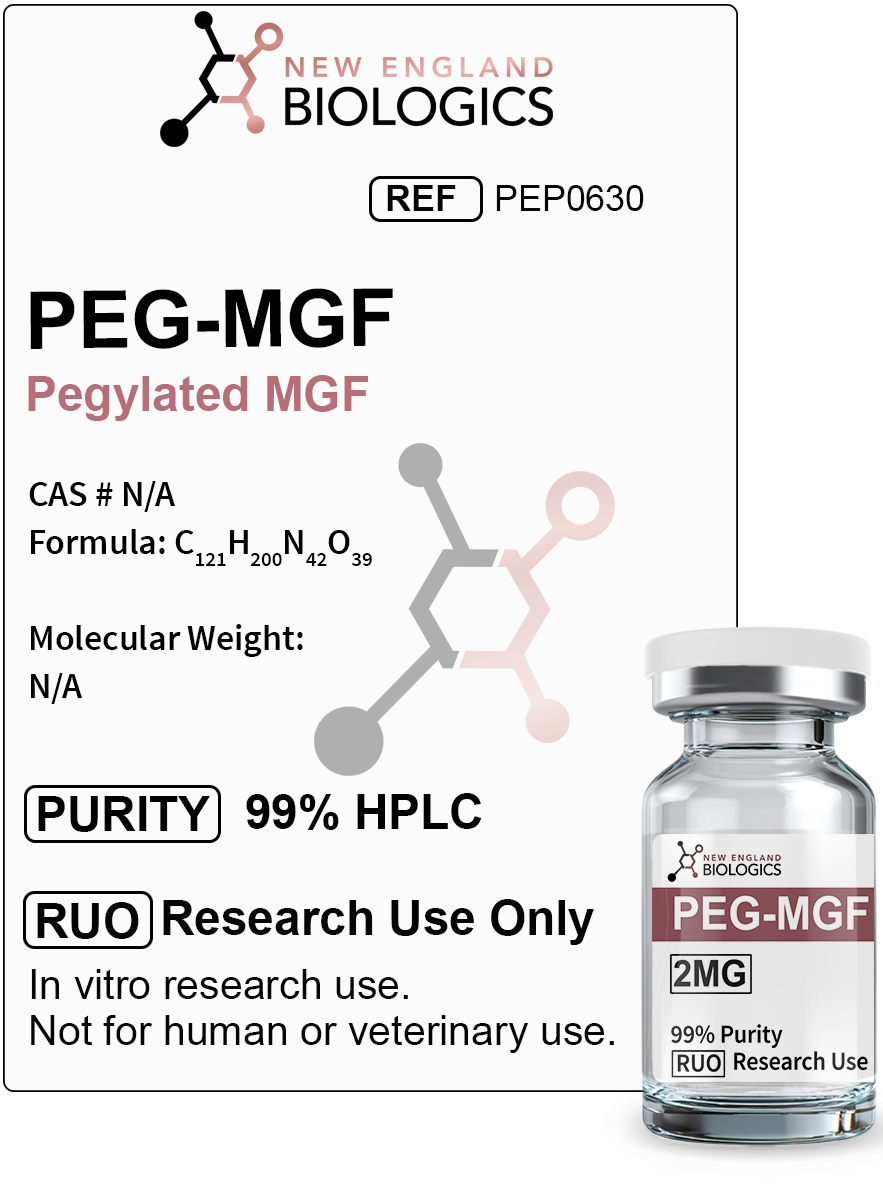
PEG-MGF 2mg
Peptides
What is PEG-MGF?
PEG-MGF (Pegylated Mechano Growth Factor) is a modified form of Mechano Growth Factor (MGF), also known as IGF-1Ec in humans and IGF-1Eb in rodents. MGF is a splice variant of the insulin-like growth factor-1 (IGF-1) gene that is distinguished by its unique C-terminal E-domain peptide sequence, which differs significantly from other IGF-1 isoforms. This 24-amino acid E-domain region confers distinct biological properties independent from the mature IGF-1 protein.
MGF is produced locally within tissues in response to mechanical stress, physical activity, or tissue damage. Unlike systemic IGF-1, which is primarily produced by the liver and circulates throughout the body, MGF acts in an autocrine and paracrine manner at the site of tissue injury or mechanical stimulation. Research shows that MGF expression is rapidly upregulated within 24 hours following muscle damage or overload, preceding the expression of other IGF-1 isoforms by several days.
The pegylation process involves the attachment of polyethylene glycol (PEG) molecules to the MGF peptide, significantly extending its biological half-life and stability in circulation. This modification allows PEG-MGF to remain active in the body for prolonged periods compared to native MGF, which undergoes rapid degradation. The extended activity window provides sustained anabolic signaling that enhances the peptide's therapeutic potential for tissue repair and regeneration.
MGF's primary mechanism involves activation of muscle satellite cells—quiescent stem cells located between the sarcolemma and basal lamina of muscle fibers. Following activation by MGF, these satellite cells enter the cell cycle, proliferate, and either fuse with existing muscle fibers to support hypertrophy or fuse together to form new muscle fibers during regeneration. Unlike mature IGF-1, the E-domain of MGF specifically inhibits premature differentiation of satellite cells while promoting their proliferation, allowing for an expanded pool of myogenic precursor cells before terminal differentiation occurs.
Research indicates MGF's biological actions are mediated through multiple pathways. While mature IGF-1 primarily signals through the IGF-1 receptor, studies demonstrate that the E-domain peptide of MGF can function independently of this receptor, suggesting alternative signaling mechanisms that remain under investigation. The peptide also demonstrates significant protective effects against cellular apoptosis through interaction with anti-apoptotic proteins and activation of survival signaling pathways.
Research Applications
Muscle Repair and Satellite Cell Activation
PEG-MGF demonstrates potent effects on muscle satellite cell activation and skeletal muscle repair. Research published in the Journal of Anatomy found that MGF expression is the earliest response to muscle damage, with expression occurring immediately after injury and preceding the activation marker M-cadherin. This initial pulse of MGF expression activates quiescent satellite cells, while the later expression of IGF-1Ea maintains protein synthesis to complete the repair process.
Studies in primary human muscle cell cultures show that the MGF E-domain peptide significantly increases the proliferative lifespan of satellite cells isolated from neonatal and young adult subjects. The peptide enhances satellite cell activation, proliferation, and fusion potential for muscle repair and maintenance. Research demonstrates MGF treatment increases satellite cell proliferation while delaying terminal differentiation, providing an extended window for muscle repair before cells commit to a myogenic program.
In skeletal muscle regeneration studies following ischemia or myotoxin-induced damage, MGF expression surges within hours of injury, with levels remaining elevated for several days. This temporal expression pattern correlates directly with satellite cell activation and myoblast proliferation, establishing MGF as a critical early-phase repair signal. The peptide elevates superoxide dismutase activity, protecting satellite cells from reactive oxygen species-induced damage during the inflammatory phase of muscle repair.
Sources:
- Hill M, et al. "Muscle satellite (stem) cell activation during local tissue injury and repair." Journal of Anatomy. 2003;203(1):89-99. https://pmc.ncbi.nlm.nih.gov/articles/PMC1571137/
- Kandalla PK, et al. "Mechano Growth Factor E peptide (MGF-E), derived from an isoform of IGF-1, activates human muscle progenitor cells and induces an increase in their fusion potential at different ages." Experimental Gerontology. 2011;46(5):326-337. https://pubmed.ncbi.nlm.nih.gov/21354439/
- Chen X, et al. "Stem cell activation in skeletal muscle regeneration." Cellular and Molecular Life Sciences. 2015;72(9):1663-1677. https://link.springer.com/article/10.1007/s00018-014-1819-5
Muscle Growth and Hypertrophy
Research demonstrates MGF plays a critical role in exercise-induced muscle adaptation and hypertrophy. Studies show MGF mRNA expression in skeletal muscle increases significantly within 2 hours following eccentric exercise in healthy young men, with no concurrent changes in IGF-1Ea expression. This specific upregulation of MGF correlates with expression of Myf5, a known driver of satellite cell proliferation, establishing a temporal relationship between MGF and myogenic activation.
Animal studies reveal that MGF treatment following muscle damage results in 4-6 fold increases in expression within 72 hours, corresponding with enhanced skeletal muscle cell growth and differentiation. The peptide promotes hypertrophy through multiple mechanisms including increased myonuclei addition via satellite cell fusion, enhanced protein synthesis, and inhibition of myostatin expression—a negative regulator of muscle mass.
In cell culture studies, MGF demonstrates distinct effects compared to mature IGF-1. While mature IGF-1 promotes both proliferation and differentiation of myoblasts, MGF specifically enhances proliferation while inhibiting terminal differentiation. This unique property allows for accumulation of a larger pool of proliferative myoblasts before differentiation, potentially contributing to greater muscle mass gains. Research shows MGF treatment of C2C12 myoblasts results in increased proliferation rates without premature fusion into myotubes.
Studies in growth hormone-deficient models demonstrate that exogenous growth hormone administration preferentially increases muscle MGF expression over other IGF-1 variants. This finding suggests MGF may mediate some of the muscle-building effects traditionally attributed to growth hormone, providing a mechanistic link between hormonal regulation and local muscle tissue remodeling.
Sources:
- Hameed M, et al. "Expression of IGF-I splice variants in young and old human skeletal muscle after high resistance exercise." Journal of Physiology. 2003;547(Pt 1):247-254. https://www.frontiersin.org/journals/physiology/articles/10.3389/fphys.2015.00283/full
- Yang SY, Goldspink G. "Different roles of the IGF-I Ec peptide (MGF) and mature IGF-I in myoblast proliferation and differentiation." FEBS Letters. 2002;522(1-3):156-160. https://pmc.ncbi.nlm.nih.gov/articles/PMC3485521/
- Hayashi S, et al. "Muscle mechano growth factor is preferentially induced by growth hormone in growth hormone-deficient lit/lit mice." Journal of Physiology. 2006;573(Pt 1):84-92. https://pmc.ncbi.nlm.nih.gov/articles/PMC1665252/
Cardiac Protection and Cardiovascular Health
PEG-MGF exhibits significant cardioprotective effects in models of myocardial infarction. Research published in Heart Lung and Circulation demonstrates that treatment with the MGF E-domain peptide improves cardiac function following acute myocardial infarction in sheep models. In controlled studies, MGF E-domain treatment resulted in 35% less compromised cardiac muscle compared to untreated controls, with complete absence of cleaved caspase-3 immunostaining in treated hearts, indicating reduced apoptosis and infarct expansion.
Pressure-volume analysis studies show MGF E-domain administration preserves contractile function and prevents pathologic hypertrophy following myocardial infarction. Treatment decreased mortality and ameliorated the decline in hemodynamic parameters, delaying progression to decompensated heart failure. These protective effects persist for at least 10 weeks post-infarction, suggesting sustained therapeutic benefit from acute-phase treatment.
Research demonstrates localized delivery of MGF E-domain peptide via polymeric microstructures further enhances cardiac protection. Intramyocardial injection of peptide-eluting microrods following coronary artery ligation reduced cellular apoptosis, attracted human mesenchymal stem cells to the injury site, and preserved cardiac function. The peptide increases expression of anti-apoptotic protein Bcl-2 in cardiac myocytes, providing cellular protection during ischemic stress.
Studies show MGF expression is temporally regulated in response to myocardial ischemia, with expression induced within one hour and remaining elevated for up to 8 weeks following infarction. This endogenous upregulation suggests MGF plays a natural protective role in cardiac repair. Administration of exogenous MGF E-domain amplifies this endogenous response, mobilizing resident cardiac stem cell populations including c-Kit+ and Sca-1+ cells, which contribute to cardiac tissue regeneration.
Sources:
- Carpenter V, et al. "Mechano-growth factor reduces loss of cardiac function in acute myocardial infarction." Heart Lung and Circulation. 2008;17(1):33-39. https://pubmed.ncbi.nlm.nih.gov/17581790/
- Peña JR, et al. "Localized delivery of mechano-growth factor E-domain peptide via polymeric microstructures improves cardiac function following myocardial infarction." Biomaterials. 2015;46:26-34. https://pmc.ncbi.nlm.nih.gov/articles/PMC4328136/
- Doroudian G, et al. "Sustained delivery of MGF peptide from microrods attracts stem cells and reduces apoptosis of myocytes." Biomedical Microdevices. 2014;16(5):705-715. https://pmc.ncbi.nlm.nih.gov/articles/PMC4418932/
Neuroprotection and Brain Injury Recovery
PEG-MGF demonstrates significant neuroprotective properties in models of brain ischemia and neurodegeneration. Research published in The FASEB Journal shows that in gerbil models of transient brain ischemia, treatment with synthetic MGF C-terminal peptide provides substantial protection to vulnerable neurons. Ischemia induces increased expression of endogenous MGF in ischemia-resistant hippocampal neurons, suggesting MGF serves an important endogenous neuroprotective function during cerebral injury.
In organotypic hippocampal culture models of neurodegeneration, MGF peptide demonstrates potency equivalent to full-length IGF-1 in preventing neuronal cell death, with effects lasting significantly longer than recombinant IGF-1. This extended duration of neuroprotection reflects the peptide's enhanced stability and sustained biological activity. Notably, the neuroprotective action of MGF E-domain operates independently of the IGF-1 receptor, indicating a novel mechanism of action distinct from traditional IGF-1 signaling.
Studies show MGF provides effective protection against both oxidative stress and NMDA-induced excitotoxicity—two primary pathological cascades activated during ischemic brain injury. In models of hypoxia-ischemia, neonatal brain insults produce increased and prolonged expression of MGF but not other IGF-1 isoforms. MGF overexpression has been detected in regenerating brain regions following global adult brain ischemia, correlating with areas of active neuronal repair and regeneration.
Research in amyotrophic lateral sclerosis (ALS) models demonstrates MGF treatment significantly improves progressive muscle weakness and increases motor neuron survival. In these studies, MGF treatment proves superior to other IGF-1 isoforms in protecting motor neurons, slowing disease progression, and maintaining neuromuscular function. These findings suggest potential therapeutic applications for MGF in neurodegenerative conditions affecting motor neurons.
Sources:
- Dłużniewska J, et al. "A strong neuroprotective effect of the autonomous C-terminal peptide of IGF-1 Ec (MGF) in brain ischemia." The FASEB Journal. 2005;19(13):1896-1898. https://pubmed.ncbi.nlm.nih.gov/16144956/
- Beresewicz M, et al. "The expression of the insulin-like growth factor system during postnatal development of the rat hippocampus." Neurochemical Research. 2010;35(5):769-777. https://pmc.ncbi.nlm.nih.gov/articles/PMC3485521/
- Riddoch-Contreras J, et al. "Mechano-growth factor protects against mechanical overload-induced damage in skeletal muscle." Growth Hormone & IGF Research. 2009;19(6):452-460. https://pmc.ncbi.nlm.nih.gov/articles/PMC3485521/
Aging and Sarcopenia Prevention
Research demonstrates MGF expression and responsiveness decline with aging, contributing to age-related muscle loss and sarcopenia. Studies show elderly individuals have decreased ability to express the autocrine form of MGF in response to mechanical overload compared to younger subjects. In muscle biopsies from elderly persons, satellite cells isolated and treated with MGF E-domain peptide show restored proliferative capacity and delayed senescence, though this effect is diminished in cells from very old individuals compared to young adults.
Clinical research published in BMC Musculoskeletal Disorders establishes that sarcopenia is associated with decreased IGF-1 signaling, particularly the MGF splice variant. In elderly populations, reduced MGF expression in skeletal muscle cells correlates with decreased muscle mass and functional decline. The study identifies MGF as independently associated with reduction of skeletal muscle mass, along with body mass index and gender, suggesting MGF deficiency plays a causative role in sarcopenia pathogenesis.
Aging reduces the compliance of skeletal muscle to mechanical stimuli, accompanied by decreased capacity to synthesize and secrete MGF. With increasing age, satellite cell reserves decline and their activation becomes impaired, limiting muscle regenerative capacity. MGF treatment has been shown to enhance satellite cell activation even in aged muscle, providing a potential therapeutic strategy to combat age-related muscle atrophy. The peptide's ability to activate dormant satellite cells and promote their proliferation offers promise for maintaining muscle mass and function in elderly populations.
Studies in rodent models demonstrate that MGF expression following muscle damage is significantly reduced in aged animals compared to young counterparts. This age-dependent decline in MGF responsiveness correlates with impaired muscle repair and decreased satellite cell activation. However, administration of exogenous MGF peptide can partially overcome this age-related deficit, restoring satellite cell function and promoting muscle regeneration in elderly subjects. These findings suggest MGF supplementation may provide a strategy to counteract sarcopenia by compensating for age-related decline in endogenous MGF production.
Sources:
- Owino V, et al. "Age-related loss of skeletal muscle function and the inability to express the autocrine form of insulin-like growth factor-1 (MGF) in response to mechanical overload." FEBS Letters. 2001;505(2):259-263. https://link.springer.com/article/10.1007/s00018-014-1819-5
- Wang H, et al. "Association between sarcopenia and levels of growth hormone and insulin-like growth factor-1 in the elderly." BMC Musculoskeletal Disorders. 2020;21(1):214. https://bmcmusculoskeletdisord.biomedcentral.com/articles/10.1186/s12891-020-03236-y
- Degens H. "Sarcopenia: Aging-Related Loss of Muscle Mass and Function." Physiological Reviews. 2019;99(1):427-511. https://pubmed.ncbi.nlm.nih.gov/30427277/