What is MOTS-c?
MOTS-C (Mitochondrial Open Reading Frame of the 12S rRNA Type-C) is a naturally occurring bioactive peptide encoded within the mitochondrial genome, specifically from a short open reading frame in the 12S ribosomal RNA region. Discovered in 2015, this 16-amino acid peptide represents a novel class of mitochondrial-derived peptides that serve as signaling molecules between mitochondria and cellular systems.
MOTS-C functions as a metabolic regulator with the unique ability to translocate from the mitochondria to the nucleus during periods of metabolic stress, where it directly influences nuclear gene expression. The peptide primarily targets skeletal muscle tissue and regulates energy metabolism through the folate-AICAR-AMPK signaling pathway, a critical mechanism for cellular energy balance and metabolic adaptation.
Research has identified MOTS-C as highly conserved across species, particularly in the first 11 amino acid residues, suggesting its fundamental importance in metabolic regulation. The peptide is naturally expressed in various tissues including skeletal muscle, heart, and liver, and is also found in systemic circulation. Notably, endogenous MOTS-C levels are induced by physical exercise and decline with aging, making it a key factor in age-related metabolic dysfunction and physical decline.
The peptide's mechanism of action involves inhibiting the folate cycle and its associated de novo purine biosynthesis pathway, leading to the accumulation of 5-aminoimidazole-4-carboxamide ribonucleotide (AICAR), a potent activator of AMP-activated protein kinase (AMPK). This activation cascade triggers numerous beneficial metabolic effects including enhanced glucose uptake, increased fatty acid oxidation, improved insulin sensitivity, and activation of stress response pathways that promote cellular resilience and longevity.
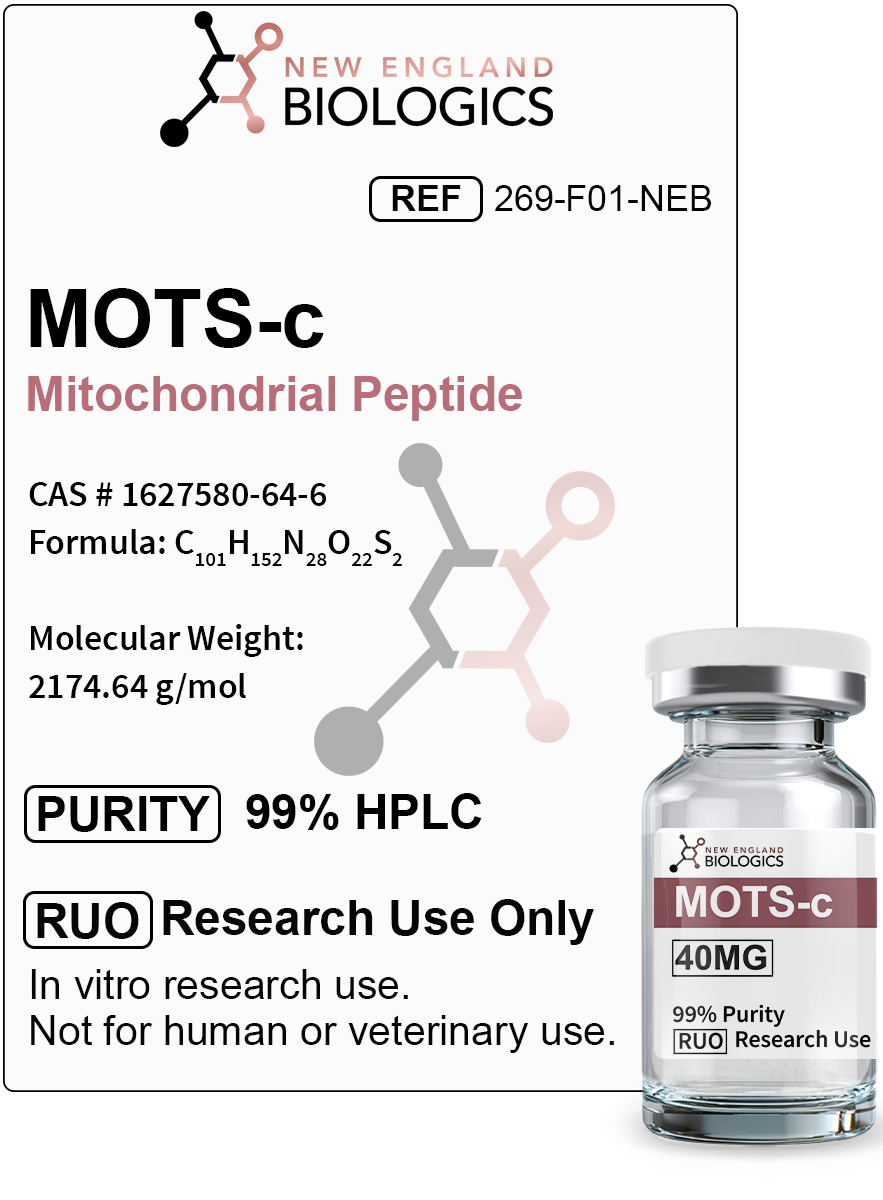
Chemical Identity
The compound is characterized by its unique molecular structure and specific chemical properties that make it valuable for research applications.Purity & Quality
Our MOTS-c is provided at research-grade purity, suitable for laboratory applications and experimental protocols. Each batch undergoes quality control testing to ensure consistency and reliability for your research needs. Important: This product is intended for research purposes only and is not for human or veterinary use. It is sold for laboratory and scientific investigation only.MOTS-c Structure
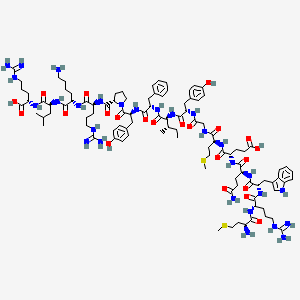
Chemical Structure
2D Structure
3D Structure

Chemical Properties
| CAS Number | 1627580-64-6 |
|---|---|
| Molecular Formula | C101H152N28O22S2 |
| Molecular Weight | 2174.6 g/mol |
| IUPAC Name |
(4S)-4-[[(2S)-5-amino-2-[[(2S)-2-[[(2S)-2-[[(2S)-2-amino-4-methylsulfanylbutanoyl]amino]-5-carbamimidamidopentanoyl]amino]-3-(1H-indol-3-yl)propanoyl]amino]-5-oxopentanoyl]amino]-5-[[(2S)-1-[[2-[[(2S)-1-[[(2S,3S)-1-[[(2S)-1-[[(2S)-1-[(2S)-2-[[(2S)-1-[[(2S)-6-amino-1-[[(2S)-1-[[(1S)-4-carbamimidamido-1-carboxybutyl]amino]-4-methyl-1-oxopentan-2-yl]amino]-1-oxohexan-2-yl]amino]-5-carbamimidamido-1-oxopentan-2-yl]carbamoyl]pyrrolidin-1-yl]-3-(4-hydroxyphenyl)-1-oxopropan-2-yl]amino]-1-oxo-3-phenylpropan-2-yl]amino]-3-methyl-1-oxopentan-2-yl]amino]-3-(4-hydroxyphenyl)-1-oxopropan-2-yl]amino]-2-oxoethyl]amino]-4-methylsulfanyl-1-oxobutan-2-yl]amino]-5-oxopentanoic acid
|
| InChIKey | WYTHCOXVWRKRAH-LOKRTKBUSA-N |
MOTS-c Research
Research Applications
Exercise Performance and Muscle Function
Studies demonstrate that MOTS-C significantly enhances physical performance and skeletal muscle function. Research published in Nature Communications found that exercise induces endogenous MOTS-C expression in skeletal muscle and circulation in humans, with levels increasing 11.9-fold in skeletal muscle immediately following acute exercise. In controlled trials, a single dose of MOTS-C administered to mice improved total running time by 12% and distance by 15% during acute exercise testing, demonstrating its exercise-mimetic properties.
Long-term exercise training studies show that 4-8 weeks of voluntary running increases MOTS-C protein expression 1.5-5-fold in skeletal muscle, with sustained elevation persisting for 4-6 weeks during detraining periods. The peptide enhances exercise endurance through multiple mechanisms: improving skeletal muscle metabolism, activating the AMPK/PGC-1α pathway, and directly binding to and activating casein kinase 2 (CK2), a key regulator of muscle homeostasis.
Sources:
- Reynolds JC, et al. "MOTS-c is an exercise-induced mitochondrial-encoded regulator of age-dependent physical decline and muscle homeostasis." Nature Communications. 2021;12:470. https://www.nature.com/articles/s41467-020-20790-0
- Hyatt JP, et al. "MOTS-c increases in skeletal muscle following long-term physical activity and improves acute exercise performance after a single dose." Physiological Reports. 2022;10(13):e15377. https://pmc.ncbi.nlm.nih.gov/articles/PMC9270643/
- Wan J, et al. "MOTS-c modulates skeletal muscle function by directly binding and activating CK2." iScience. 2024;27(10):110212. https://pmc.ncbi.nlm.nih.gov/articles/PMC11570452/
Metabolic Health and Fat Loss
MOTS-C demonstrates significant effects on metabolic homeostasis and obesity prevention. Animal studies show that MOTS-C treatment prevents diet-induced obesity even when caloric intake remains unchanged, indicating enhanced metabolic efficiency rather than appetite suppression. Research published in Cell Metabolism demonstrates that MOTS-C administration to mice on high-fat diets prevented obesity, improved glucose homeostasis, and dramatically reduced hepatic lipid accumulation.
The peptide enhances insulin sensitivity in skeletal muscle by promoting AMPK activation and GLUT4 expression, leading to increased glucose uptake independent of insulin stimulation. Metabolomic analyses reveal that MOTS-C reduces pathways associated with obesity and type 2 diabetes, including sphingolipid metabolism, monoacylglycerol metabolism, and dicarboxylate metabolism. Treatment with MOTS-C significantly increases fatty acid oxidation and β-oxidation in skeletal muscle, promoting the utilization of stored fat as an energy source.
Studies demonstrate that MOTS-C reduces circulating inflammatory markers (IL-6 and TNF-α) implicated in obesity pathogenesis and insulin resistance. The peptide's ability to enhance metabolic flexibility—the capacity to switch between carbohydrate and fat oxidation—makes it particularly valuable for combating metabolic syndrome and related disorders.
Sources:
- Lee C, et al. "The Mitochondrial-derived peptide MOTS-c promotes metabolic homeostasis and reduces obesity and insulin resistance." Cell Metabolism. 2015;21(3):443-454. https://pmc.ncbi.nlm.nih.gov/articles/PMC4350682/
- Kim KH, et al. "The mitochondrial-derived peptide MOTS-c is a regulator of plasma metabolites and enhances insulin sensitivity." Physiological Reports. 2019;7(13):e14171. https://physoc.onlinelibrary.wiley.com/doi/10.14814/phy2.14171
- Yang T, et al. "Endurance training enhances skeletal muscle mitochondrial respiration by promoting MOTS-c secretion." Physiology & Behavior. 2025;273:114447. https://www.sciencedirect.com/science/article/abs/pii/S089158492401147X
Aging and Cellular Protection
Research indicates MOTS-C plays a crucial role in healthy aging and age-related disease prevention. Studies demonstrate that circulating MOTS-C levels decline approximately 21% in individuals aged 70-81 compared to those aged 18-30, correlating with age-related metabolic decline and reduced physical capacity. Late-life initiated MOTS-C treatment (beginning at 23.5 months in mice) significantly increased physical capacity and healthspan, demonstrating therapeutic potential even when treatment begins in advanced age.
The peptide enhances mitochondrial function and promotes stress resilience through nuclear translocation during metabolic stress, where it regulates genes containing antioxidant response elements (ARE). This mechanism provides cellular protection against oxidative stress and metabolic dysfunction associated with aging. MOTS-C treatment improves skeletal muscle metabolism in aged mice to levels comparable to young animals, reversing age-dependent insulin resistance and physical decline.
Studies show MOTS-C prevents pancreatic β-cell senescence in both type 1 and type 2 diabetes models by modulating nuclear gene expression and metabolites involved in cellular senescence. The peptide significantly downregulates pro-inflammatory cytokines (IL-6, IL-1β, TNF-α) and reduces markers of cellular aging, supporting its role in promoting longevity and reducing age-related pathological changes.
Sources:
- Yen K, et al. "MOTS-c, the Most Recent Mitochondrial Derived Peptide in Human Aging and Age-Related Diseases." International Journal of Molecular Sciences. 2022;23(19):11991. https://www.ncbi.nlm.nih.gov/pmc/articles/PMC9570330/
- Kong BS, et al. "Mitochondrial-encoded peptide MOTS-c prevents pancreatic islet cell senescence to delay diabetes." Experimental & Molecular Medicine. 2025;57:1861-1873. https://www.nature.com/articles/s12276-025-01521-1
- Guo W, et al. "Mitochondria-derived peptide MOTS-c: effects and mechanisms related to stress, metabolism and aging." Journal of Translational Medicine. 2023;21:36. https://link.springer.com/article/10.1186/s12967-023-03885-2
Cardiovascular and Tissue Repair
MOTS-C demonstrates protective effects in cardiovascular health and tissue repair mechanisms. Research shows that the peptide restores mitochondrial respiration in type 2 diabetic heart tissue by improving mitochondrial bioenergetic function, increasing ATP production, and lowering oxidative stress levels. Studies indicate that MOTS-C treatment improves cardiac function in diabetic models by enhancing glucose metabolism and upregulating antioxidant defenses.
The peptide exhibits anti-inflammatory properties through multiple mechanisms, including reduction of pro-inflammatory cytokines and modulation of inflammatory signaling pathways. In studies of nonalcoholic steatohepatitis (NASH), MOTS-C treatment alleviated liver steatosis, cellular apoptosis, inflammation, and fibrosis. The peptide's direct interaction with B-cell lymphoma-2 (Bcl-2) increases protein stability and suppresses apoptosis, providing cellular protection during metabolic stress.
Research in autoimmune diabetes models shows MOTS-C treatment downregulates inflammatory IFN-γ and IL-17A cytokine production while increasing the proportion of regulatory T cells (Tregs), demonstrating immunomodulatory effects. The peptide prevents muscle atrophy by suppressing myostatin expression and muscle atrophy signaling pathways, supporting tissue preservation during metabolic challenges.
Sources:
- Pham T, et al. "Mitochondria-derived peptide MOTS-c restores mitochondrial respiration in type 2 diabetic heart." Frontiers in Physiology. 2025;16:1602271. https://www.frontiersin.org/journals/physiology/articles/10.3389/fphys.2025.1602271/full
- Sato M, et al. "The mitochondrial genome-encoded peptide MOTS-c interacts with Bcl-2 to alleviate nonalcoholic steatohepatitis progression." Cell Reports. 2024;43(1):113591. https://www.sciencedirect.com/science/article/pii/S2211124723015991
- Cho YM, et al. "Mitochondrial-Encoded Peptide MOTS-c, Diabetes, and Aging-Related Diseases." Diabetes & Metabolism Journal. 2023;47(3):315-323. https://www.e-dmj.org/journal/view.php?doi=10.4093/dmj.2022.0333
Muscle Preservation and Anti-Atrophy Effects
MOTS-C demonstrates significant muscle-protective properties, particularly in preventing age-related and disease-induced muscle loss. Research shows that MOTS-C administration attenuates high-fat diet-induced skeletal muscle wasting by suppressing myostatin mRNA expression—a strong negative regulator of muscle mass—and inhibiting muscle atrophy signaling pathways. The peptide modulates skeletal muscle fiber type composition, promoting adaptations associated with enhanced oxidative capacity and endurance.
Studies indicate that MOTS-C treatment preserves lean muscle mass during caloric restriction or metabolic stress conditions where muscle catabolism typically occurs. This muscle-sparing effect is mediated through AMPK activation and enhanced protein synthesis signaling, allowing for fat loss while maintaining or even increasing muscle tissue. The peptide's ability to activate CK2, a key regulator of muscle homeostasis, contributes to improved muscle function and resistance to atrophy.
In aging models, MOTS-C treatment maintains skeletal muscle homeostasis by regulating genes involved in proteostasis (protein quality control), heat shock response, and metabolic adaptation. These effects translate to preserved physical function and exercise capacity in aged subjects, suggesting therapeutic potential for sarcopenia and age-related muscle decline.
Sources:
- Kumagai H, et al. "MOTS-c reduces myostatin and muscle atrophy signaling." American Journal of Physiology-Endocrinology and Metabolism. 2021;320(4):E680-E690. https://pubmed.ncbi.nlm.nih.gov/33554779
- Liu C, et al. "MOTS-c: A promising mitochondrial-derived peptide for therapeutic exploitation." Frontiers in Physiology. 2023;14:1120533. https://pmc.ncbi.nlm.nih.gov/articles/PMC9905433/
- Reynolds JC, et al. "MOTS-c is an exercise-induced mitochondrial-encoded regulator of age-dependent physical decline and muscle homeostasis." Nature Communications. 2021;12:470. https://pmc.ncbi.nlm.nih.gov/articles/PMC7817847/