What is Dihexa?
Dihexa (N-hexanoic-Tyr-Ile-(6) aminohexanoic amide), also known by its developmental code PNB-0408, is a synthetic oligopeptide developed by researchers at Washington State University as a metabolically stable derivative of angiotensin IV. This compound represents a significant advancement in neuropharmacology as it was specifically engineered to overcome the limitations of its parent molecule—primarily poor blood-brain barrier penetration and rapid metabolic degradation.
The peptide's development focused on enhancing hydrophobicity, decreasing hydrogen bonding potential, and increasing metabolic stability, resulting in a compound with an exceptionally long plasma half-life of approximately 335 minutes. Unlike angiotensin IV, which cannot effectively penetrate brain tissue, Dihexa possesses the unique ability to cross the blood-brain barrier when administered orally, making it a viable candidate for therapeutic applications in neurodegenerative conditions.
Dihexa functions through a sophisticated mechanism involving the hepatocyte growth factor (HGF) and its receptor c-Met, a receptor tyrosine kinase system critically involved in neuronal growth, survival, and synaptic plasticity. Research has demonstrated that Dihexa binds to HGF with remarkably high affinity (Kd = 65 picomolar) and acts as an allosteric modulator, potentiating HGF activity even at subthreshold concentrations. This interaction triggers c-Met phosphorylation and activates downstream signaling cascades including the PI3K/AKT and MAPK/ERK pathways, which are fundamental to neuronal survival, dendritic arborization, and synapse formation.
The compound's procognitive effects stem from its ability to enhance synaptogenesis—the formation of new functional synapses between neurons—particularly in the hippocampus, a brain region essential for learning and memory consolidation. Studies demonstrate that Dihexa promotes dendritic spine formation, increases synaptic density, and enhances miniature excitatory postsynaptic currents (mEPSCs), indicating the formation of functional glutamatergic synapses. Notably, in comparative assays measuring neurotrophic activity, Dihexa exhibited potency seven orders of magnitude greater than brain-derived neurotrophic factor (BDNF) in promoting new neuronal connections.
The peptide's therapeutic potential extends beyond mere neuroprotection to actual neural repair and regeneration. Research indicates that Dihexa not only prevents neuronal damage but actively promotes recovery of cognitive function in animal models of Alzheimer's disease-like impairment, demonstrating its unique capacity to reverse rather than simply slow cognitive decline. This regenerative capability, combined with its oral bioavailability and blood-brain barrier penetration, positions Dihexa as a compound of significant interest for treating neurodegenerative conditions and age-related cognitive decline.
Dihexa Structure
Chemical Structure
2D Structure

3D Structure

Chemical Properties
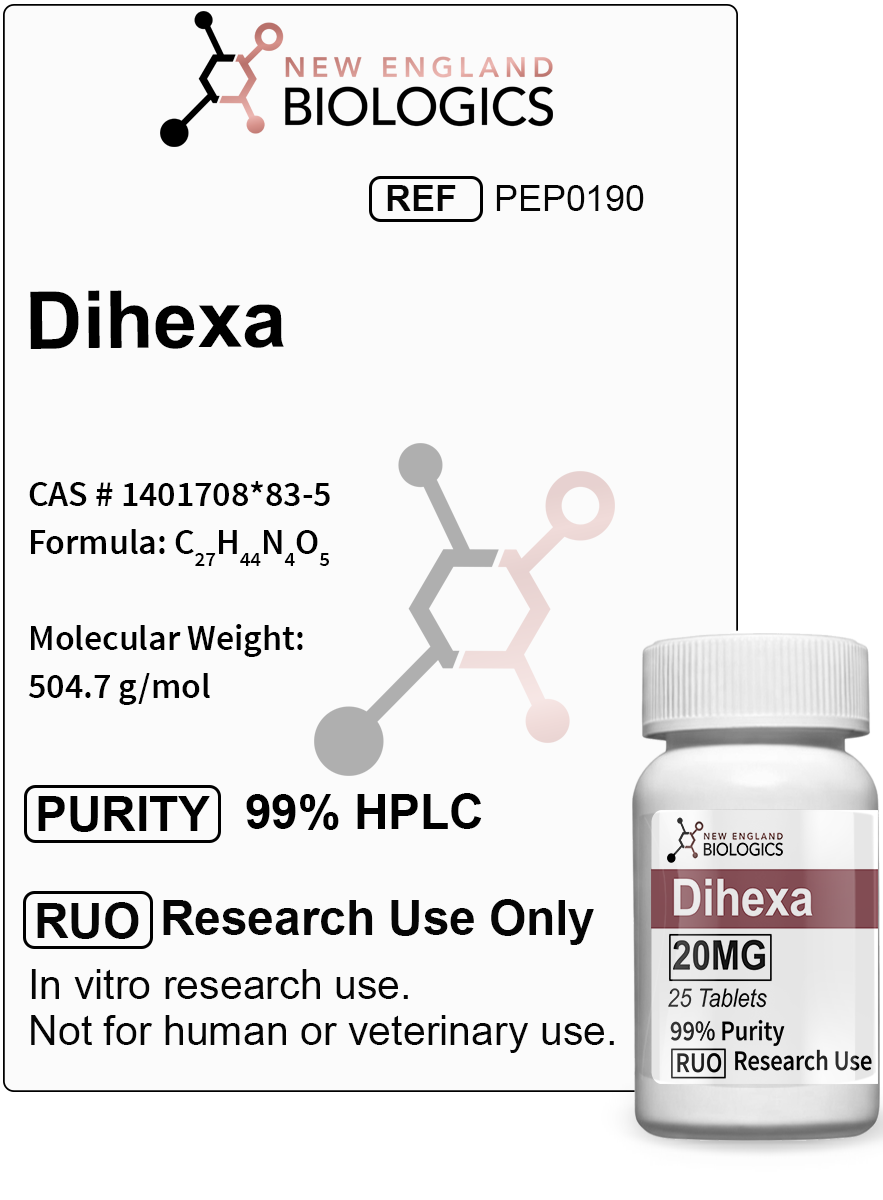
| CAS Number | 1401708-83-5 |
|---|---|
| Molecular Formula | C27H44N4O5 |
| Molecular Weight | 504.7 g/mol |
| IUPAC Name |
(2S,3S)-N-(6-amino-6-oxohexyl)-2-[[(2S)-2-(hexanoylamino)-3-(4-hydroxyphenyl)propanoyl]amino]-3-methylpentanamide
|
| InChIKey | XEUVNVNAVKZSPT-JTJYXVOQSA-N |
Dihexa Research
Cognitive Enhancement and Memory Formation
Dihexa demonstrates remarkable efficacy in enhancing cognitive function and restoring memory in animal models of cognitive impairment. Research published in the Journal of Pharmacology and Experimental Therapeutics established that Dihexa treatment reversed scopolamine-induced cognitive deficits in rats, with treated animals performing comparably to healthy controls in Morris water maze spatial learning tasks. When administered either orally, intraperitoneally, or intracerebroventricularly at various doses, Dihexa-treated rats showed significantly improved performance in both acquisition trials and probe trials measuring spatial memory retention.
Studies in aged rats further demonstrate Dihexa's potential for age-related cognitive decline. Aged animals typically exhibit difficulty with spatial learning tasks, yet Dihexa treatment enabled these older rats to perform at levels comparable to young animals, suggesting the compound's capacity to restore age-compromised cognitive function. The peptide's effects on memory consolidation appear mediated through enhanced hippocampal long-term potentiation (LTP), the neurophysiological basis of memory storage, with Dihexa treatment increasing both the magnitude and persistence of synaptic strengthening.
The mechanism underlying these cognitive improvements involves direct enhancement of synaptic connectivity. Research shows Dihexa increases dendritic spine density by 40-50% in hippocampal neurons, with these new spines demonstrating functional characteristics of mature synapses including colocalization with presynaptic markers synapsin and VGLUT1, and generation of enhanced excitatory postsynaptic currents. This structural plasticity translates to improved information processing and memory encoding capacity in treated animals.
Sources:
- Benoist CC, et al. "The procognitive and synaptogenic effects of angiotensin IV-derived peptides are dependent on activation of the hepatocyte growth factor/c-met system." Journal of Pharmacology and Experimental Therapeutics. 2014;351(2):390-402. https://pubmed.ncbi.nlm.nih.gov/25187433/
- Wright JW, Harding JW. "The Brain Hepatocyte Growth Factor/c-Met Receptor System: A New Target for the Treatment of Alzheimer's Disease." Journal of Alzheimer's Disease. 2015;45(4):985-1000. https://pubmed.ncbi.nlm.nih.gov/25649658/
Neuroprotection and Alzheimer's Disease Models
Research in transgenic Alzheimer's disease models reveals Dihexa's significant neuroprotective and therapeutic properties. Studies using APP/PS1 mice—a well-established model of Alzheimer's pathology—demonstrate that Dihexa administration restored spatial learning and cognitive functions to near-wildtype levels as measured by Morris water maze performance. Treatment with Dihexa at doses of 1.44-2.88 mg/kg administered intragastrically for three months significantly reduced escape latency and increased time spent in the target quadrant during probe trials.
Histological analysis revealed that Dihexa treatment increased neuronal cell counts and enhanced expression of synaptophysin (SYP), a presynaptic protein marker indicating synaptic density, in the hippocampus of APP/PS1 mice. These findings suggest Dihexa not only prevents synaptic loss but actively promotes synapse formation even in the presence of Alzheimer's pathology. The peptide's neuroprotective mechanisms involve activation of the PI3K/AKT signaling pathway, which plays crucial roles in neuronal survival, protein synthesis, and protection against apoptosis.
Dihexa demonstrates potent anti-neuroinflammatory effects critical for neuroprotection. Studies show the peptide markedly decreases activation of astrocytes and microglia—the brain's primary immune cells whose chronic activation contributes to neurodegeneration. Treatment significantly reduced levels of pro-inflammatory cytokines including interleukin-1β (IL-1β) and tumor necrosis factor-α (TNF-α) while increasing anti-inflammatory interleukin-10 (IL-10) expression. This modulation of neuroinflammation, combined with enhanced synaptic plasticity, contributes to Dihexa's capacity to improve cognitive outcomes in Alzheimer's models.
The compound provides cellular protection against oxidative stress and metabolic impairment. Neuronal cultures pretreated with Dihexa show significantly higher survival rates when exposed to oxidative stress or excitotoxic conditions compared to untreated neurons. This protective effect involves upregulation of antioxidant enzymes and maintenance of mitochondrial membrane potential, indicating Dihexa activates endogenous cellular defense mechanisms that guard against neuronal injury.
Sources:
- Wang X, et al. "AngIV-Analog Dihexa Rescues Cognitive Impairment and Recovers Memory in the APP/PS1 Mouse via the PI3K/AKT Signaling Pathway." International Journal of Molecular Sciences. 2021;22(21):11435. https://pmc.ncbi.nlm.nih.gov/articles/PMC8615599/
- Wright JW, Kawas LH, Harding JW. "The development of small molecule angiotensin IV analogs to treat Alzheimer's and Parkinson's diseases." Progress in Neurobiology. 2015;125:26-46. https://pubmed.ncbi.nlm.nih.gov/25455861/
Synaptogenesis and Neuroplasticity
Dihexa's defining characteristic is its exceptional capacity to promote synaptogenesis and enhance neuroplasticity through activation of the HGF/c-Met receptor system. Research demonstrates that Dihexa induces hippocampal spinogenesis with potency comparable to HGF itself, significantly increasing the number of dendritic spines per unit length of dendrite in both dissociated neuronal cultures and organotypic hippocampal slice preparations. Treatment with picomolar to nanomolar concentrations of Dihexa produces dose-dependent increases in spine density, with maximal effects observed at 10-12 M concentrations.
The newly formed synapses induced by Dihexa treatment are functionally active rather than merely structural. Electrophysiological recordings demonstrate that Dihexa-treated neurons exhibit significantly increased frequency of miniature excitatory postsynaptic currents (mEPSCs), indicating enhanced synaptic transmission. Immunofluorescence studies confirm that Dihexa-induced dendritic spines display high colocalization (>95%) with both universal presynaptic marker synapsin and glutamatergic presynaptic marker VGLUT1, establishing that these are functional glutamatergic synapses capable of neurotransmission.
Dihexa's synaptogenic effects require activation of the c-Met receptor, as demonstrated by experiments using c-Met-specific short hairpin RNA (shRNA) which completely abolished Dihexa's capacity to induce spine formation. Furthermore, the HGF antagonist peptide Hinge blocked both Dihexa-induced spinogenesis and the associated increases in mEPSC frequency, confirming that Dihexa's procognitive effects are mediated specifically through the HGF/c-Met signaling system. This mechanism distinguishes Dihexa from conventional nootropics that modulate neurotransmitter systems without promoting structural brain changes.
Research indicates that Dihexa's effects on neuroplasticity involve distinct intracellular signaling pathways that mediate different aspects of neuronal development. Activation of the PI3K/AKT pathway primarily drives synapse formation and density increases, while MAPK/ERK pathway activation predominantly influences dendritic growth and arborization. This dual-pathway activation enables Dihexa to simultaneously enhance both the structural complexity of neuronal dendrites and the density of synaptic connections, maximizing the neuron's capacity for information processing and storage.
Sources:
- Eagleson KL, et al. "Distinct intracellular signaling mediates C-MET regulation of dendritic growth and synaptogenesis." Developmental Neurobiology. 2016;76(10):1160-1181. https://pubmed.ncbi.nlm.nih.gov/26818605/
- Akimoto M, et al. "Hepatocyte growth factor as an enhancer of NMDA currents and synaptic plasticity in the hippocampus." Neuroscience. 2004;128(1):155-162. https://pubmed.ncbi.nlm.nih.gov/15450362/
Neuroregeneration and Brain Injury Recovery
Dihexa demonstrates significant potential for neural repair and recovery from brain injury through its activation of regenerative pathways. The HGF/c-Met system, which Dihexa potentiates, plays essential roles in tissue repair, cell growth, and neuroprotection across various injury models. Research indicates that HGF activation provides neuroprotective effects in cerebral ischemia, spinal cord injuries, and traumatic brain damage by promoting neuronal survival, stimulating angiogenesis, and reducing apoptosis.
Studies in neurodegenerative disease models suggest Dihexa's regenerative capabilities extend to reversing existing damage rather than merely preventing further deterioration. In APP/PS1 Alzheimer's mice, Dihexa treatment not only prevented cognitive decline but actively restored spatial learning abilities that had already been compromised, indicating the compound promotes recovery of function in damaged neural circuits. This regenerative capacity appears mediated through Dihexa's ability to stimulate formation of new functional synapses, effectively rebuilding communication networks between neurons that had been disrupted by disease processes.
The peptide's effects on neurogenesis and neural progenitor cells further contribute to its regenerative potential. While direct evidence for Dihexa's effects on neurogenesis remains limited, the HGF/c-Met system that Dihexa activates is known to stimulate stem cell differentiation and promote neurogenesis in the adult hippocampus. Long-term potentiation (LTP), which Dihexa enhances, has been shown to stimulate proliferation of progenitor cells in the dentate gyrus and promote survival of newly born neurons, suggesting Dihexa may facilitate neural regeneration through multiple complementary mechanisms.
Research indicates Dihexa may support recovery from various forms of neural damage including stroke, traumatic brain injury, and neurodegenerative conditions. Gene therapy studies using HGF have demonstrated beneficial effects in animal models of amyotrophic lateral sclerosis (ALS), multiple sclerosis (MS), and cerebral ischemia, with HGF treatment promoting neurite extension, increasing synaptogenesis, and enhancing functional recovery. As a small molecule that mimics and potentiates HGF activity while maintaining oral bioavailability and blood-brain barrier penetration, Dihexa offers practical advantages over gene therapy or protein-based approaches for clinical translation.
Sources:
- Takeuchi S, et al. "Intracerebral hemorrhage triggers the brain HGF-MET pathway to protect neurons from apoptotic death." Stroke. 2013;44(6):1752-1758. https://pubmed.ncbi.nlm.nih.gov/23633531/
- Date I, et al. "Enhanced recovery of the nigrostriatal dopaminergic system in MPTP-treated mice following intrastriatal injection of genetically modified cells expressing HGF." Journal of Neuroscience Research. 2004;78(4):474-481. https://pubmed.ncbi.nlm.nih.gov/15372565/
- Achim K, et al. "The role of Tal2 and Tal1 in the differentiation of midbrain GABAergic neuron precursors." Biology Open. 2013;2(10):990-997. https://pmc.ncbi.nlm.nih.gov/articles/PMC3798176/
Anti-Inflammatory and Cellular Protection
Dihexa exhibits potent anti-inflammatory properties that contribute significantly to its neuroprotective profile. Research in APP/PS1 Alzheimer's mice demonstrates that Dihexa treatment markedly reduces activation of astrocytes and microglia, the brain's primary inflammatory cells. Chronic activation of these glial cells drives neuroinflammatory processes that accelerate neurodegeneration, making their modulation a critical therapeutic target. Dihexa significantly decreased levels of pro-inflammatory cytokines including interleukin-1β (IL-1β) and tumor necrosis factor-α (TNF-α), both implicated in synaptic dysfunction and neuronal death in Alzheimer's disease.
Importantly, Dihexa simultaneously increases expression of anti-inflammatory interleukin-10 (IL-10), suggesting the peptide actively shifts the neuroinflammatory balance toward resolution rather than simply suppressing inflammation. This modulation of inflammatory signaling occurs through activation of the PI3K/AKT pathway, which possesses intrinsic anti-inflammatory properties including inhibition of pro-inflammatory cytokine release and enhancement of cellular stress resistance. The peptide's anti-inflammatory effects complement its synaptogenic properties, as chronic neuroinflammation actively disrupts synaptic function and prevents formation of new synapses.
Dihexa provides robust cellular protection against oxidative stress and metabolic challenges. Neurons pretreated with Dihexa demonstrate significantly enhanced survival when exposed to reactive oxygen species, excitotoxic glutamate concentrations, or metabolic impairment compared to untreated controls. This cytoprotective effect involves upregulation of antioxidant defense systems and stabilization of mitochondrial function, with Dihexa-treated cells maintaining healthier mitochondrial membrane potentials under stress conditions. The peptide appears to activate cellular stress response pathways that prepare neurons to withstand subsequent insults.
The compound's protective mechanisms extend to preservation of synaptic proteins and prevention of synapse loss. Research shows Dihexa treatment increases expression of synaptophysin and other synaptic markers even in disease models characterized by synaptic degeneration. By simultaneously reducing inflammatory damage, enhancing cellular resilience, and promoting synapse formation, Dihexa addresses multiple pathological processes that contribute to cognitive decline, offering comprehensive neuroprotection rather than targeting a single disease mechanism.
Sources:
- Wang X, et al. "AngIV-Analog Dihexa Rescues Cognitive Impairment and Recovers Memory in the APP/PS1 Mouse via the PI3K/AKT Signaling Pathway." International Journal of Molecular Sciences. 2021;22(21):11435. https://pmc.ncbi.nlm.nih.gov/articles/PMC8615599/
- Shimamura M, et al. "Novel therapeutic strategy to treat brain ischemia: overexpression of hepatocyte growth factor gene reduced ischemic injury without cerebral edema in rat model." Circulation. 2004;109(3):424-431. https://pubmed.ncbi.nlm.nih.gov/14707018/
- Hayashi K, et al. "Regional differences in the neurotrophic effects of hepatocyte growth factor after spinal cord injury." Journal of Neuroscience Research. 2005;82(6):817-827. https://pubmed.ncbi.nlm.nih.gov/16273544/